

AI is remarkably good at finding a way through unfamiliar work. It can inspect a system, choose tools, recover from a dead end, and reach a useful result.
That is powerful. It is also expensive to repeat.
Without a durable method, the next run starts almost where the first one did: reasoning again, exploring again, and paying again to rediscover what the organization already learned.
AI is good at finding a way. The enterprise needs a way it can trust twice.
Keep the harness. Add memory.
Rote is a tool that works with the agent harness your team already uses—Codex, Claude, Kimi, or another harness.
It does not replace the model. It does not rewrite the prompt. It does not ask people to change how they work.
The agent still reasons and acts as usual. Rote watches the work alongside it.
Keep the harness. Add memory.
- READsystem state
- CALLtool result
- CHECKeffect
- KEEPsuccessful path
The agent behaves as it does today. Rote observes the work and keeps the successful method.
Watch the work. Keep the method.
During exploration, an agent may search, read, call an API, run a command, reject an answer, and try a better path. Rote turns those actions into a behavioral trace: a structured record of which tools were used, what each action depended on, and what produced the successful result.
The trace is evidence, not a transcript. It describes behavior the system can inspect and run.
From exploration to operation.
- 01EXPLORE
The agent reasons, tries tools, and adapts.
- 02TRACE
Rote records actions, results, and dependencies.
- 03GRAPH
The wandering becomes a causal path.
- 04PLAY
The proven path becomes an inspectable workflow.
- 05REPLAY
Fresh inputs run through the same verified method.
The trace is also a safety record
Guard destructive operations. Rote uses the trace to make risky effects visible, apply policy, and put approval in front of actions that can damage systems or data.
Keep mistakes useful. When an organization chooses to retain them, failed actions can be archived as evaluation cases—and later used for supervised improvement or retraining.
What went wrong becomes evidence. What went right becomes the operational graph.
The successful run becomes an operational graph
A successful run is rarely a straight line. There are retries, checks, and dead ends. Rote converts that activity into a graph of the useful actions and their dependencies.
Then it keeps the proven causal path: the tools that mattered, the order that mattered, the inputs that can change, and the outputs that define “done.”
Keep what mattered. Remove the wandering.
CAUSAL PATH
- 01READ
- 02DECIDE
- 03WRITE
Not a theoretical “perfect” workflow. The shortest verified path from the run that actually succeeded.
The DAG is the durable, language-neutral asset. It can be compiled into the program and runtime an organization chooses. Rote is starting with TypeScript because it is portable, familiar, and easy to distribute.
The graph becomes an operating asset
A Play is the durable operating asset created from that graph.
It is an inspectable, versioned workflow with explicit inputs, tools, effects, and outputs. A person or agent can see what it needs before it runs. Fresh inputs can move through the same verified method without asking a model to rediscover the entire approach.
This is deterministic execution around probabilistic intelligence. The agent is free to discover. The Play is built to repeat.
Reason once. Reuse many times.
Reasoning tokens move from repeated rediscovery to the first good run. Future runs spend their budget on execution, not recollection.
Not every task should become a Play. The best candidates are repeated jobs where the method matters: investigations, reviews, reporting, onboarding, operational checks, and decisions that pull from several systems.
One pattern. Many functions.
The tools may be different in security, finance, support, engineering, or go-to-market. The operating pattern is the same.
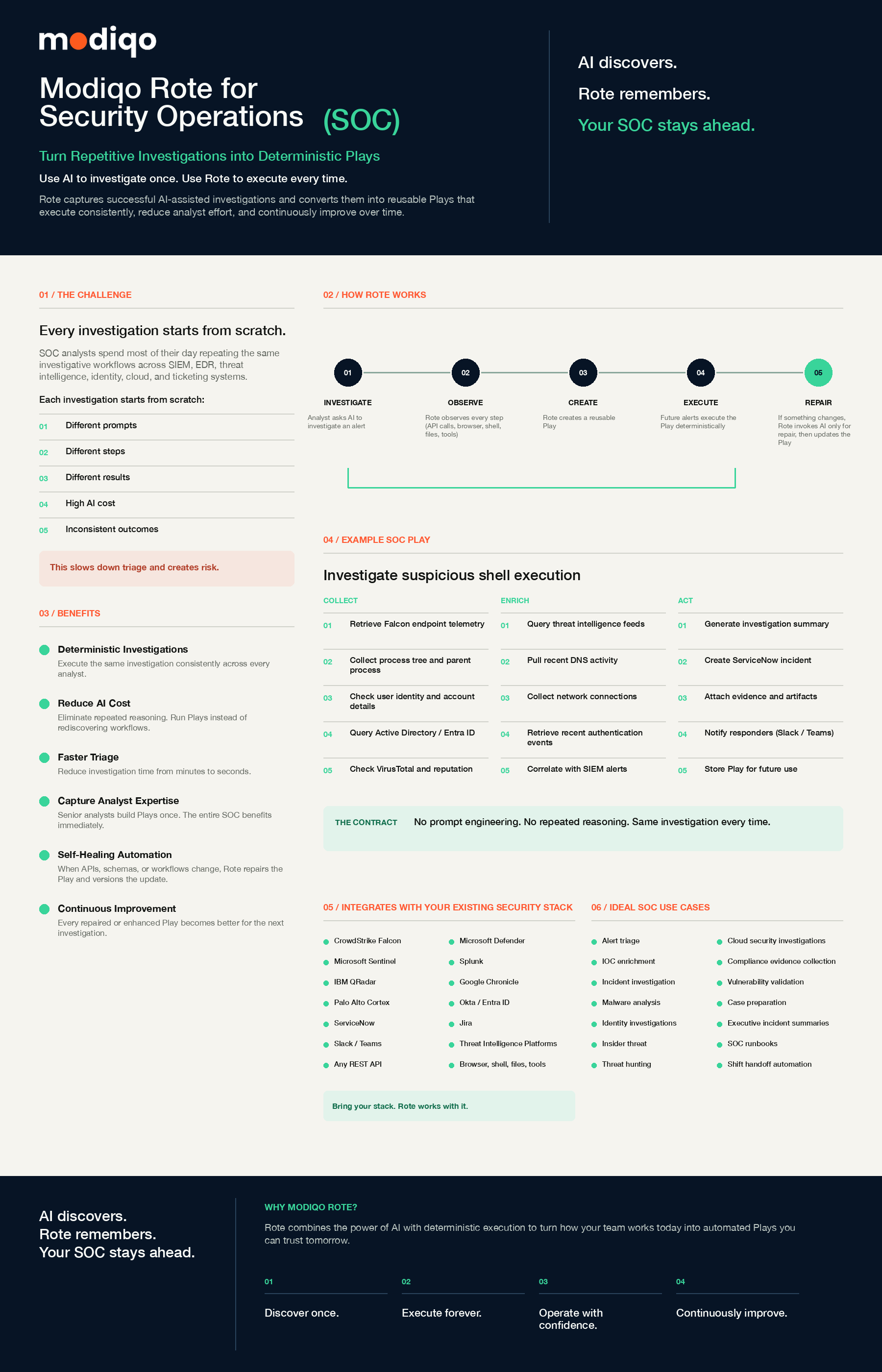
Modiqo Rote for Security Operations (SOC).
The complete SOC story in one poster: challenge, operating loop, shell investigation Play, benefits, integrations, use cases, and outcomes.
Three things to remember
No rip and replace. Rote works with the harnesses and tools already in use.
No behavior change. People guide the agent as they do today; Rote observes what succeeds.
No permanent rediscovery tax. A strong run becomes a Play that can be inspected, governed, shared, and executed again.
The strategic shift is simple: successful agent work stops disappearing at the end of the conversation. It becomes part of how the organization operates.